
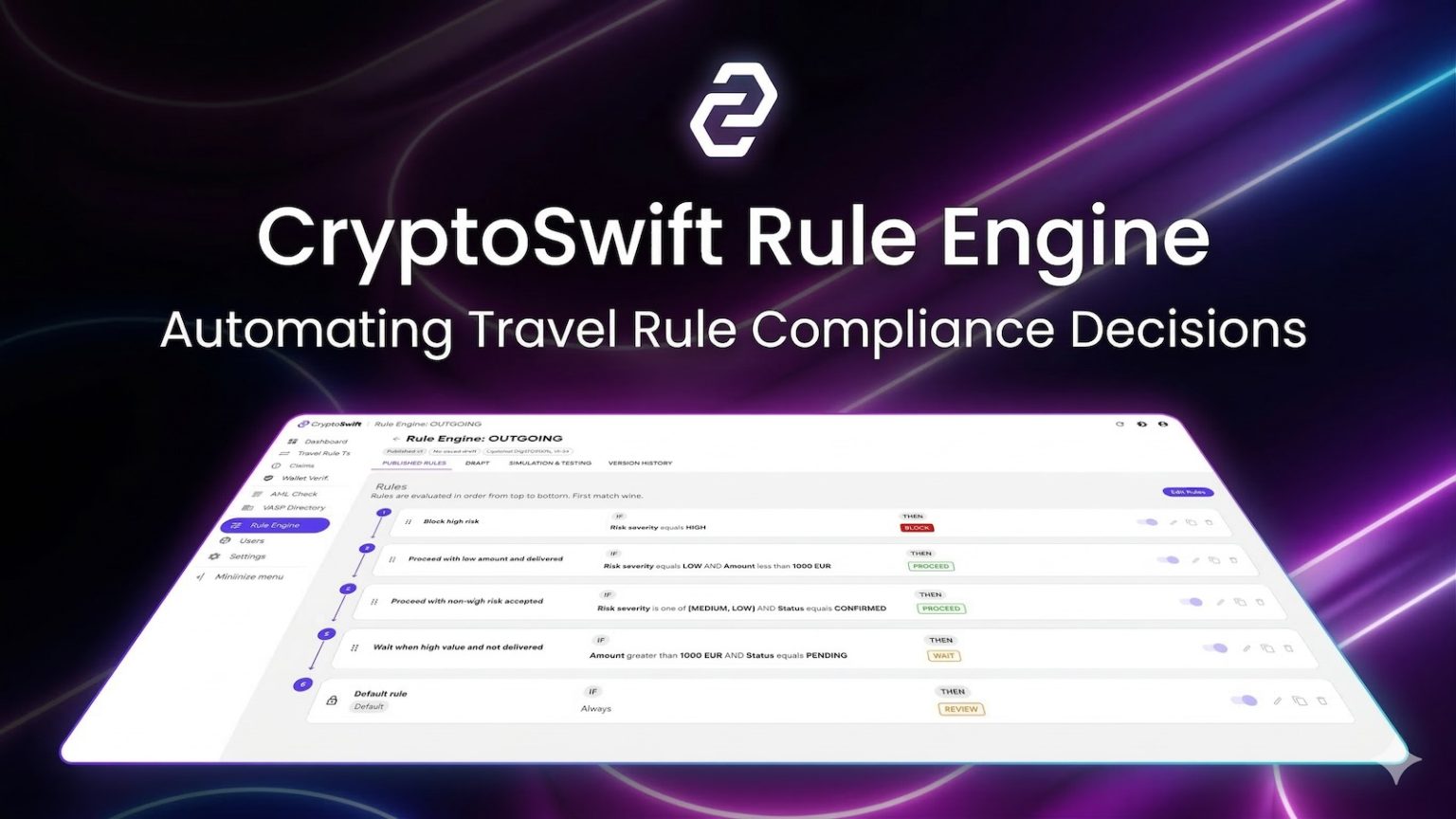

Over the past months we’ve been shipping quite a lot of new capabilities at CryptoSwift. We introduced Travel Rule risk scoring, built a global VASP directory, integrated AML checks directly into the dashboard, improved wallet verification, and completely revamped our developer portal.
Each of these improvements adds valuable signals for compliance teams operating under the Crypto Travel Rule and regulations like FATF Recommendation #16 and the EU Transfer of Funds Regulation under MiCA.
But while building these features, one thing became increasingly obvious: all of them generate signals.
- Risk scores.
- VASP information.
- AML monitoring results.
- Travel Rule message statuses.
Signals are useful, but they don’t solve the operational problem by themselves. Compliance teams still have to answer the same question over and over again:
What should happen with this transaction?
- Should it proceed immediately?
- Should it be reviewed?
- Should we wait for additional confirmation?
- Or should the transaction be blocked entirely?
This is the problem the CryptoSwift Rule Engine was built to solve.
Travel Rule Compliance Is Ultimately a Decision Problem
Many Travel Rule solutions focus on one core capability: securely sending required data between Virtual Asset Service Providers (VASPs). That messaging layer is essential for compliance, but in real-world operations it’s only the first step.
Once a Travel Rule message is sent or received, platforms still need to evaluate several factors before deciding how to proceed.
Typical questions compliance teams ask include:
- Is the counterparty VASP known and regulated?
- What is their risk profile?
- What does the AML monitoring system say about the wallet address?
- Should we allow this transaction to proceed automatically?
Without a structured framework, these decisions often end up buried in application code or scattered across multiple systems.
The Rule Engine introduces a cleaner approach.
Why Compliance Logic Should Not Live in Backend Code
When crypto platforms first implement the Travel Rule, the compliance logic typically ends up hardcoded in backend services. Developers create simple conditional checks that determine whether transactions proceed or require manual review.
It usually starts with rules like:
- Allow transactions from low-risk counterparties
- Send medium-risk transactions for manual review
- Block high-risk counterparties
At first, this seems perfectly reasonable. But compliance policies rarely stay static.
Regulations evolve, risk thresholds change, internal policies adapt as teams gain operational experience.
When compliance logic lives in code, even small policy changes require developer involvement, deployments, and testing cycles. That slows down compliance teams and introduces unnecessary operational friction.
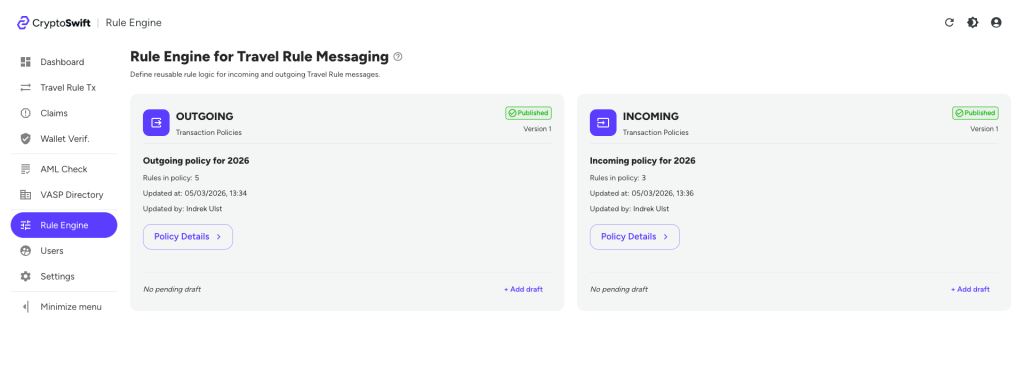
The CryptoSwift Rule Engine separates transaction signals from transaction decisions, allowing compliance teams to manage policies directly without relying on engineering changes.
A Rule Engine Designed for Travel Rule Workflows
The CryptoSwift Rule Engine acts as a decision layer on top of the data already available within the platform.
When a Travel Rule message is created, CryptoSwift may already know several things about the transaction and the counterparty involved.
For example:
- the counterparty VASP and their regulative status
- the Travel Rule risk score
- AML risk signals from wallet monitoring
- transaction attributes such as amount
- the current Travel Rule message status (was it delivered, confirmed or declined?)
Instead of forcing developers to manually combine these inputs, the Rule Engine evaluates them automatically and determines what should happen next.
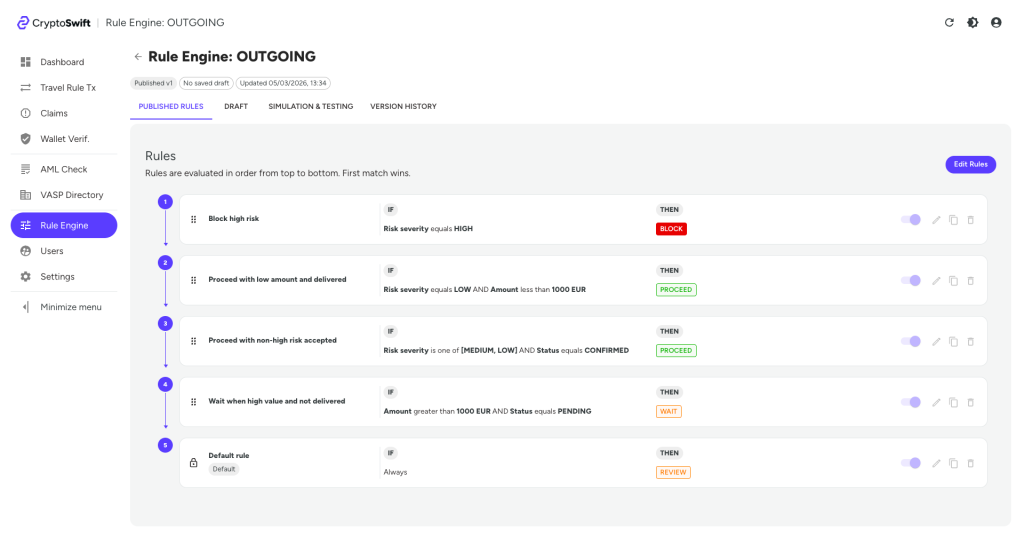
Possible outcomes include:
- Proceed with the transaction automatically
- Pause the workflow and wait for a counterparty response
- Escalate the transaction for manual compliance review
- Block the transaction entirely
The result is a clear and auditable decision process that compliance teams can configure directly in the CryptoSwift dashboard.
Supporting Both Pre-Transaction and Post-Transaction Travel Rule Flows
Crypto platforms typically implement the Travel Rule using one of two models.
Post-Transaction Workflow
In this model, the blockchain transaction is executed first and the Travel Rule message is sent afterward. This is often the fastest way to become Travel Rule compliant because it requires minimal changes to existing withdrawal flows.
Many platforms start with this approach.
Pre-Transaction Workflow
In a pre-transaction Travel Rule workflow, the Travel Rule message is created before the blockchain transaction is broadcast.
This allows the platform to evaluate compliance signals first, including:
- counterparty VASP identification
- Travel Rule risk score
- AML monitoring results
- internal compliance policies
The Rule Engine then determines whether the transaction should proceed or require additional checks.
For many platforms, this enables significantly more automation and control.
Connecting the Entire Compliance Stack
One of our design goals at CryptoSwift has always been to eliminate fragmentation in compliance tooling. Crypto platforms often end up using multiple systems for different parts of the compliance process:
- a Travel Rule messaging provider
- a separate VASP identification database
- AML monitoring tools
- manual review workflows
These systems rarely communicate with each other in a structured way.
The CryptoSwift Rule Engine connects these signals into a single decision framework. Risk scores, VASP directory data, AML monitoring results, and Travel Rule message information can now all feed into the same policy evaluation process.
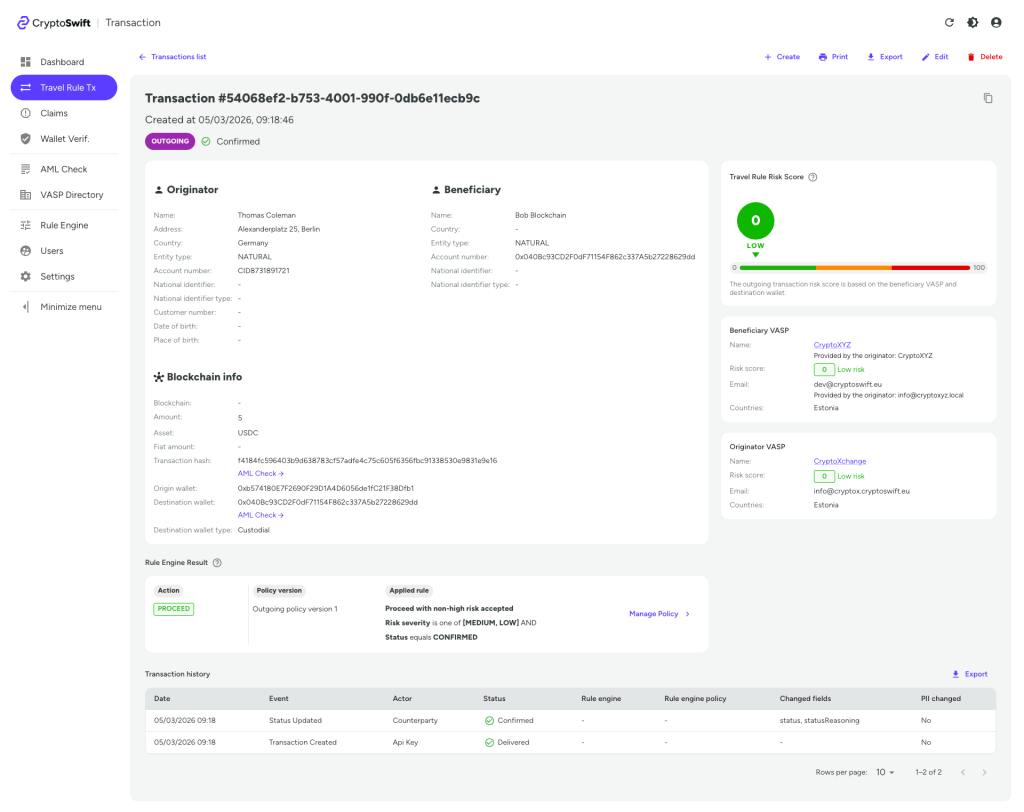
This approach simplifies operations and produces cleaner audit trails. When a transaction is blocked or escalated for review, the rule that triggered the decision is recorded alongside the transaction history. For compliance teams and regulators, that transparency is extremely valuable.
Automation Without Losing Compliance Oversight
Automation in compliance systems always raises an understandable concern: what happens when the system makes the wrong decision?
The Rule Engine is designed so automation can be introduced gradually. Some rules can allow low-risk transactions to proceed automatically, while others route transactions to manual review or pause workflows until additional information becomes available.
The goal isn’t to remove human oversight, the goal is to remove unnecessary manual work.
Most transactions are routine and predictable. Those shouldn’t require compliance officers to manually evaluate every detail. Automation allows teams to focus their attention where it actually matters.
From Travel Rule Messaging to Travel Rule Automation
The more we work in this space, the clearer it becomes that Travel Rule compliance is not just a messaging problem.
It’s a decision problem.
Who is the counterparty?
What is their risk profile?
Should the transaction proceed, wait, or be blocked?
The CryptoSwift Rule Engine turns the growing amount of Travel Rule data into clear operational decisions that platforms can automate and audit.
Available Now in the CryptoSwift Platform
The Rule Engine is now available in the CryptoSwift Client Dashboard and fully integrated with the CryptoSwift API and Travel Rule workflows.
If you’re already using CryptoSwift, you can start defining rules today. If you’re currently designing your Travel Rule implementation, our updated Developer Portal explains how to structure both pre-transaction and post-transaction workflows using the Rule Engine.
Our goal remains the same as always:
- less friction for developers
- more control for compliance teams
- more automation where it actually helps
And we’re just getting started.