
Travel Rule compliance infrastructure for regulated digital asset transfers
CryptoSwift helps VASPs and regulated institutions exchange Travel Rule data, assess counterparty and wallet risk, and automate compliance decisions through one API-first platform that works alongside your existing transaction infrastructure.
One compliance layer for your Travel Rule workflows
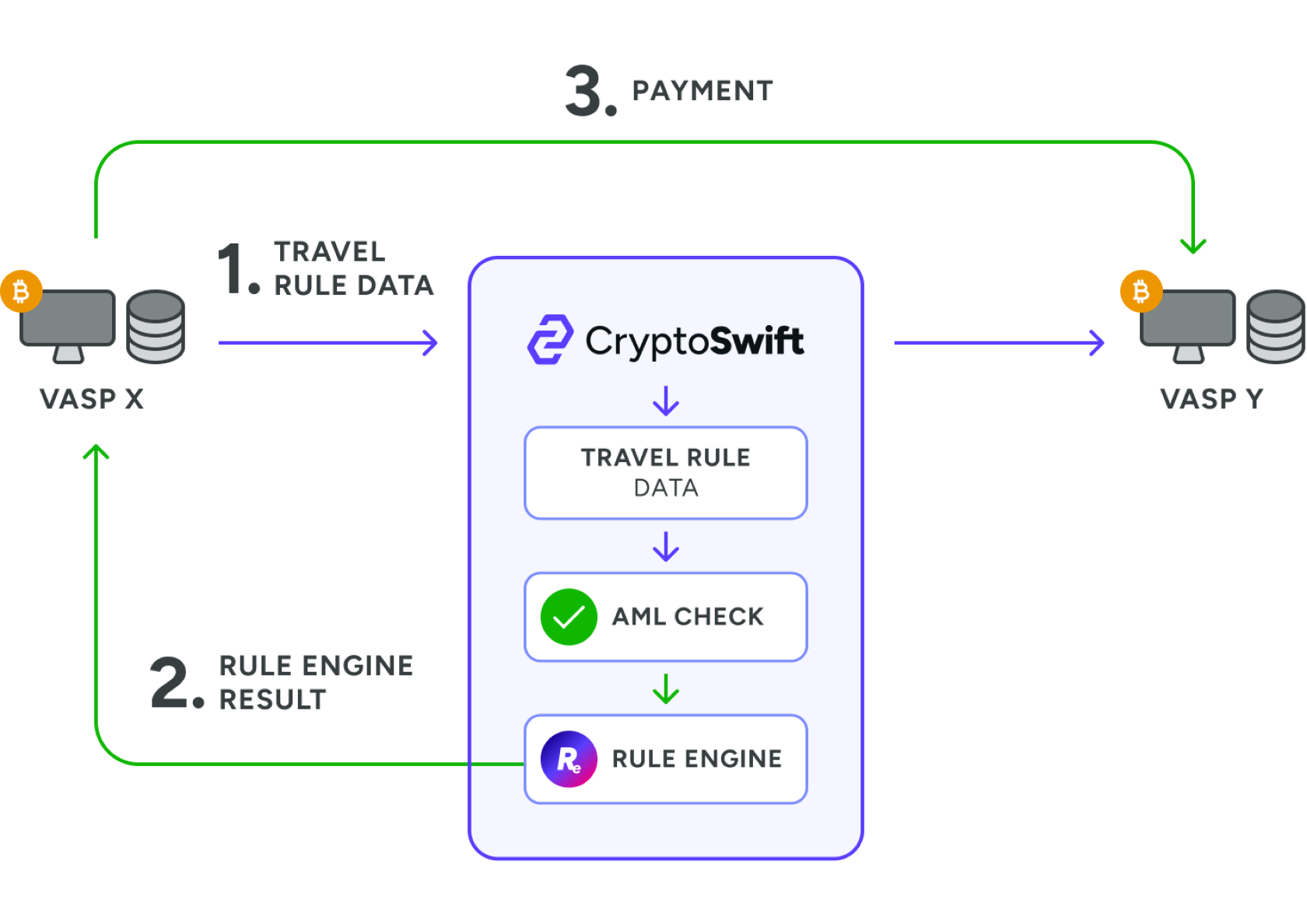
CryptoSwift works alongside your existing transaction infrastructure. You continue to execute digital asset transfers as usual, while CryptoSwift handles Travel Rule messaging, counterparty and wallet risk signals, compliance decisions, and the audit trail around each transaction.
Your team stays in control of compliance policies and approvals. CryptoSwift provides the infrastructure to execute them consistently at scale.

Exchange Travel Rule data
Send and receive Travel Rule messages with counterparty VASPs through the CryptoSwift API.

Assess the transaction
Receive message status, counterparty and wallet risk signals, and the applicable Rule Engine decision.

Apply your compliance policy
Automatically proceed with low-risk transfers or route exceptions for additional information or manual review.
Trusted by crypto businesses and financial institutions worldwide
Client Dashboard
Operational control for compliance teams
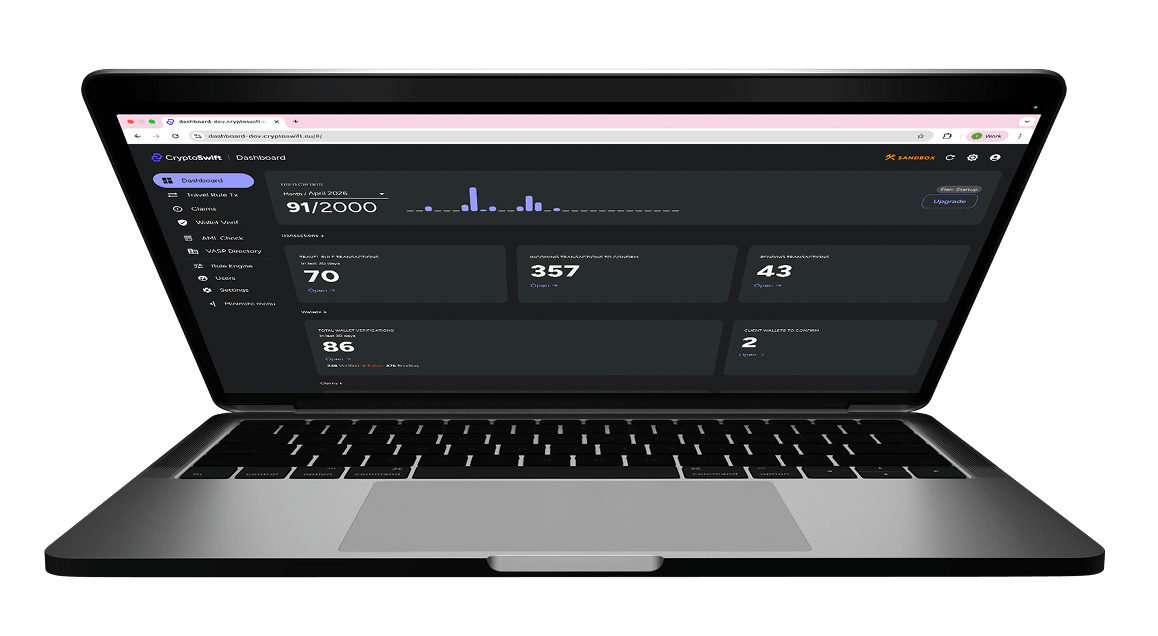
Monitor and manage Travel Rule transactions, wallet verification and compliance workflows from one interface without relying on engineering teams for day-to-day operations.
Capabilities
The Client Dashboard provides a central interface for managing Travel Rule operations, wallet verification workflows, and compliance processes.
- Transaction overview: Monitor incoming and outgoing Travel Rule transactions and wallet verification workflows
- Manual workflows: Create Travel Rule messages and initiate wallet verification directly from the dashboard
- Search & reporting: Search, filter and export transaction data for operations, investigations and regulatory reporting
- Risk assessment: Review counterparty, transaction and wallet risk using CryptoSwift and integrated KYT/AML providers
- VASP due diligence: Identify and assess counterparties using VASP directory, regulatory and risk information
- Policy management: Configure and manage automated compliance policies through the Rule Engine
- Investigation & audit: Review transaction details, risk signals, decisions and complete audit history
- Integrations: Manage wallet verification, KYT/AML providers and other platform configurations

Rule Engine
Automate compliance decisions without hard-coding policy logic
Define your compliance policies in the CryptoSwift Dashboard and apply them automatically to incoming and outgoing transactions.
The Rule Engine can evaluate signals such as Travel Rule message status, counterparty risk, wallet and on-chain risk, sanctions and watchlist screening, transaction monitoring data, and transaction attributes.
Based on your policies, CryptoSwift can return an immediate decision that your transaction workflow can use to:
- Proceed
- Wait for additional information
- Send for manual review
- Block
Policies remain controlled by your compliance team, with versioning and audit history for change management.
Travel Rule Risk Score
Built-in counterparty and wallet risk context
Every Travel Rule transaction can be evaluated using CryptoSwift’s Travel Rule Risk Score.
When the counterparty VASP is identified, the score reflects its risk profile. When the counterparty cannot be identified, wallet risk can provide additional context.
Use the Travel Rule Risk Score on its own or combine it with the Rule Engine to automatically process low-risk transactions and escalate higher-risk activity.
Built for developers
One REST API for Travel Rule messaging and compliance workflows
Integrate CryptoSwift into your existing deposit and withdrawal flows without rebuilding your transaction infrastructure.
CryptoSwift supports both post-transaction and pre-transaction Travel Rule workflows and uses STRIP, our open-source messaging standard for Travel Rule data exchange.
Features
- Real-time decisioning: API responses can include message status, risk signals and Rule Engine outcomes before funds are released
- Webhooks: Receive transaction, message and verification status updates in real time
- Sandbox environment: Test workflows using separate development credentials and endpoints
- Flexible implementation: Start with Travel Rule messaging and add risk, decisioning and verification capabilities as needed
curl --location --request POST 'https://api.cryptoswift.eu/transactions' \
--header 'x-api-key: a70fcedf-416b-4f83-845c-a05aba0d7da4' \
--header 'Content-Type: application/json' \
--data-raw '{
    "asset": "BTC",
    "amount": "0.00341",
    "blockchainInfo": {
        "origin": "0xb794f5ea0ba39494ce839613fffba74279579268",
        "destination": "0x71C7656EC7ab88b098defB751B7401B5f6d8976F"
    },
    "originator": {
        "name": "Marwin Hillar",
        "accountNumber": "04143282398",
        "address": "Alexanderplatz 25, Berlin",
        "country": "Germany"
    },
    "beneficiary": {
        "name": "Hanne Nikol",
        "accountNumber": "AB54234232"
    }
}'
CryptoSwift Outpost
Keep sensitive Travel Rule PII within your own environment
CryptoSwift Outpost extends the cloud platform with a component deployed within your infrastructure. Sensitive Travel Rule PII can remain in your own database, while the CryptoSwift cloud platform handles messaging, transaction processing and network connectivity.
This gives regulated institutions greater control over sensitive customer data while retaining access to CryptoSwift’s Travel Rule infrastructure and interoperability.
Frequently Asked Questions
What is the Crypto Travel Rule?
The Crypto Travel Rule, introduced by the Financial Action Task Force (FATF), requires Virtual Asset Service Providers (VASPs) to share specific customer information when transferring virtual assets between entities. This rule aims to combat money laundering and terrorist financing by improving transparency in crypto transactions.Who must comply with the Travel Rule?
VASPs, including cryptocurrency exchanges, wallet providers, custodians, brokers, and financial institutions handling virtual asset transactions, must comply. Compliance depends on the jurisdiction, but it generally applies to entities transferring cryptocurrencies above a specific threshold. In the European Union, under the Transfer of Funds Regulation alongside MiCA, there is a 0 EUR threshold, meaning all transfers are subject to the Travel Rule, regardless of the transaction amount.What customer information must be shared under the Travel Rule?
Under the Travel Rule, VASPs must transmit the following information for transactions:-
- Originator Information:
- Name
- Account number (or unique transaction identifier)
- Physical address or national identity number (depending on jurisdiction)
- Beneficiary Information:
- Name
- Account number (or wallet address)
- Originator Information:
How does the Travel Rule impact crypto exchanges and banks?
-
- Data Collection: ensuring accurate customer information is collected during onboarding and transactions.
- Secure Transmission: exchanging customer information securely between counterparties.
- Transaction Monitoring: identifying and flagging suspicious transactions for further investigation.
- Risk-based decision making: determining whether transactions should proceed, be reviewed, or blocked.
What are the technical challenges of implementing the Travel Rule?
-
- Interoperability — ensuring compatibility between multiple Travel Rule protocols and counterparties.
- Data privacy — protecting customer data while complying with regulations such as GDPR.
- Real-time compliance — exchanging Travel Rule data without slowing down transaction processing.
- Counterparty identification — verifying the identity and legitimacy of other VASPs.
- Automated decision workflows — determining whether transactions should proceed, be reviewed, or blocked based on compliance policies.
What solutions does CryptoSwift.eu offer for Travel Rule compliance?
-
- Send and receive Travel Rule messages securely between VASPs.
- Evaluate counterparty risk using Travel Rule risk scoring.
- Automate compliance decisions using configurable Rule Engine policies.
- Verify self-hosted wallets through integrated wallet verification tools.
- Integrate easily via a developer-friendly REST API.
What is the difference between pre-transaction and post-transaction Travel Rule workflows?
What is the Travel Rule risk score?
-
- automatically approve low-risk transactions
- flag medium-risk transactions for review
- block high-risk counterparties
What is the CryptoSwift Rule Engine?
-
- Travel Rule message status
- counterparty responses
- risk scores
- transaction attributes such as amount
Is the Travel Rule only for international transactions?
What is the threshold for Travel Rule applicability?
Does the Travel Rule apply to DeFi transactions?
How does the Travel Rule align with GDPR and data privacy laws?
-
- minimizing the data collected and transmitted
- using encryption to secure sensitive information
- supporting jurisdictional privacy requirements while maintaining transparency for regulators
What protocols are available for Travel Rule compliance?
-
- STRIP — open-source protocol created by CryptoSwift
- TRP — OpenVASP Travel Rule Protocol
- TRUST — Travel Rule Universal Solution Technology (closed network)
- Sygna Bridge
- TRISA
- VerifyVASP
How can I start implementing the Travel Rule in my organization?
- Conduct a gap analysis of your current compliance processes.
- Choose a Travel Rule solution provider, like CryptoSwift.eu, that aligns with your operational needs.
- Integrate the chosen solution into your transaction workflows.
- Train your compliance and technical teams on the new processes.
- Monitor and adapt to regulatory changes.
How can CryptoSwift.eu help me stay ahead of regulatory changes?
Can I test CryptoSwift.eu’s Travel Rule solution before full integration?
-
- simulate Travel Rule transactions
- validate data security and accuracy
- test counterparty interoperability before live deployment
- validate risk scoring and compliance workflows