
Self-hosted wallet verification, designed for regulated customer journeys
Collect and retain wallet ownership evidence using verification methods integrated into onboarding, withdrawal, and deposit workflows.
A best-in-class verification experience
Compliance without friction
Use a responsive, multi-language widget to guide customers through verification. The interface can be themed with your branding, including logo, fonts, and colours – all the way to white-label.
Trusted by crypto companies worldwide
Fully customisable
Consistent UX without sacrificing control
The proof-of-wallet control / proof-of-disposal-rights verification can look like you. Apply branding and configuration through theme settings, including logos, typography, and colour schemes.
Try Demo below ↓
Customise the widget
Brand
Logo URL used for branding.
Brand
Logo URL used for branding.
Typography
Font family, weight, and base sizing.
Typography
Font family, weight, and base sizing.
Colors
Text, button, and widget background colors.
Colors
Text, button, and widget background colors.
Layout
Control flow selection order and how the available space is used.
Layout
Control flow selection order and how the available space is used.
Additional steps
Collect extra information after wallet ownership verification.
Additional steps
Collect extra information after wallet ownership verification.
Buttons
Shape and emphasis for primary actions.
Buttons
Shape and emphasis for primary actions.

Multiple verification methods
Flexible evidence and additional verification steps matched to your risk-based approach
-
Cryptographic signature proofs: Verify wallet ownership by signing a message with the wallet’s private key. CryptoSwift supports 600+ of the most popular wallet apps through integrated wallet connectivity. If a wallet is not supported, or connected signing is unavailable, users can fall back to manual message signing and submit the signature directly.
-
Micro-transactions: Verify control of a wallet through a small transfer that is monitored and validated automatically (a.k.a. the penny drop or Satoshi test).
-
Visual proof: Collect photos or videos as evidence for manual wallet ownership verification.
-
Self-declaration: A lightweight fallback when stronger proof is not required or available.
Additional verification steps can be enabled when a higher level of assurance is needed
-
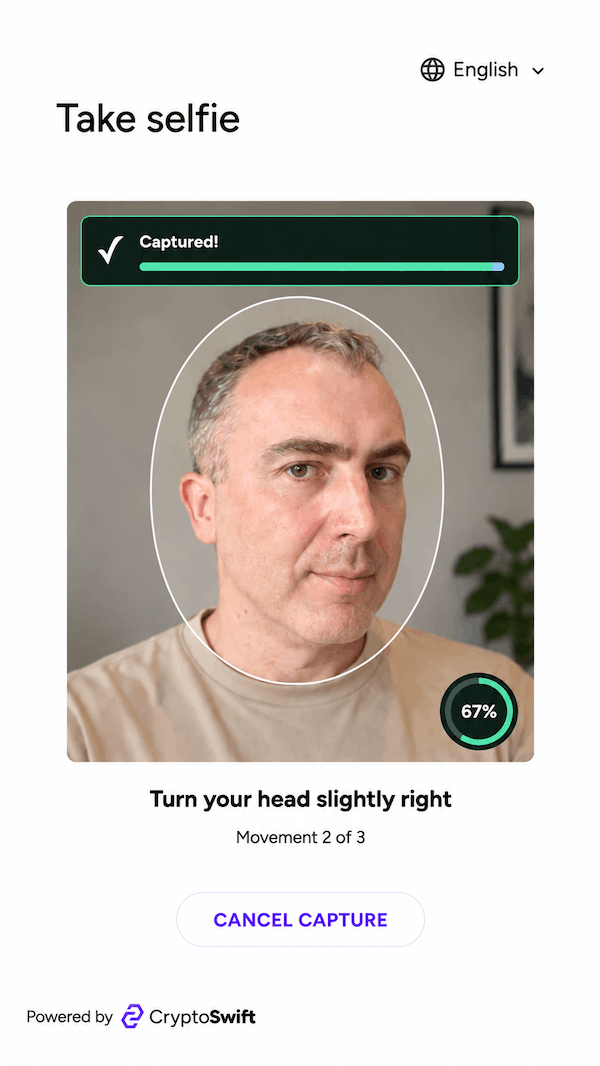
Liveness check with selfie: Ask the user to complete a guided liveness check and provide a selfie as additional evidence that a real person is completing the verification.
-
Source of Funds: Collect supporting information and documentation about the origin of the funds associated with the wallet or transaction.
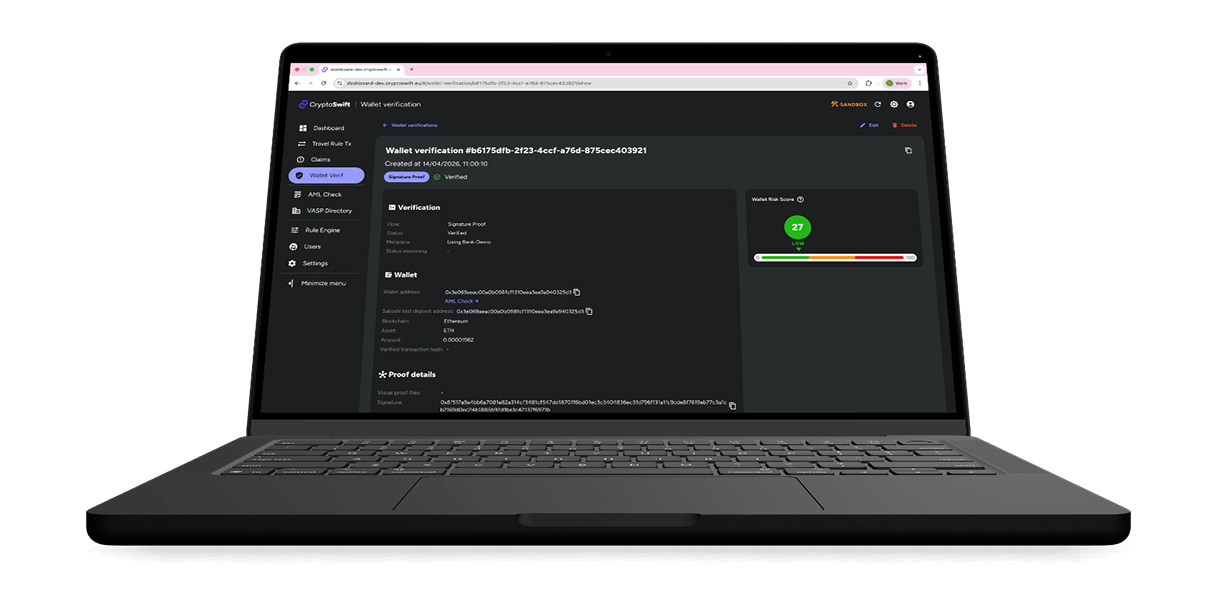
For additional compliance context, CryptoSwift also provides the wallet’s risk score out of the box using built-in KYT capabilities as part of self-hosted wallet verification. This gives compliance teams immediate visibility into the risk associated with the wallet alongside the ownership evidence collected.
These methods and additional checks can be combined into risk-based verification flows, allowing you to apply stronger verification only when required.
All verification evidence, risk information, and results can be managed and reviewed through the Client Dashboard, enabling compliance teams to assess, approve, or escalate cases within a controlled workflow.

Integration options
Embed or redirect: choose the rollout path that fits your stack
Embed the widget as a Web Component for in-app use, or use a hosted redirect flow with a secure verification link. Results are returned via webhook to your backend. For advanced use cases, integrate directly via API.

Supported blockchains
Signature-based verification supports major blockchain ecosystems, including EVM-compatible networks, Bitcoin, Solana, Tron, and others depending on wallet connectivity standards.
Where signature or transaction-based methods are not available, the verification flow remains blockchain-agnostic through visual proof and self-declaration options, ensuring consistent coverage across all wallet types.
Audit readiness
Store verification outcomes alongside transaction data and align validity rules with your risk policy to ensure traceability and evidence for compliance decisions.
Frequently Asked Questions
What is the Crypto Travel Rule?
The Crypto Travel Rule, introduced by the Financial Action Task Force (FATF), requires Virtual Asset Service Providers (VASPs) to share specific customer information when transferring virtual assets between entities. This rule aims to combat money laundering and terrorist financing by improving transparency in crypto transactions.Who must comply with the Travel Rule?
VASPs, including cryptocurrency exchanges, wallet providers, custodians, brokers, and financial institutions handling virtual asset transactions, must comply. Compliance depends on the jurisdiction, but it generally applies to entities transferring cryptocurrencies above a specific threshold. In the European Union, under the Transfer of Funds Regulation alongside MiCA, there is a 0 EUR threshold, meaning all transfers are subject to the Travel Rule, regardless of the transaction amount.What customer information must be shared under the Travel Rule?
Under the Travel Rule, VASPs must transmit the following information for transactions:-
- Originator Information:
- Name
- Account number (or unique transaction identifier)
- Physical address or national identity number (depending on jurisdiction)
- Beneficiary Information:
- Name
- Account number (or wallet address)
- Originator Information:
How does the Travel Rule impact crypto exchanges and banks?
-
- Data Collection: ensuring accurate customer information is collected during onboarding and transactions.
- Secure Transmission: exchanging customer information securely between counterparties.
- Transaction Monitoring: identifying and flagging suspicious transactions for further investigation.
- Risk-based decision making: determining whether transactions should proceed, be reviewed, or blocked.
What are the technical challenges of implementing the Travel Rule?
-
- Interoperability — ensuring compatibility between multiple Travel Rule protocols and counterparties.
- Data privacy — protecting customer data while complying with regulations such as GDPR.
- Real-time compliance — exchanging Travel Rule data without slowing down transaction processing.
- Counterparty identification — verifying the identity and legitimacy of other VASPs.
- Automated decision workflows — determining whether transactions should proceed, be reviewed, or blocked based on compliance policies.
What solutions does CryptoSwift.eu offer for Travel Rule compliance?
-
- Send and receive Travel Rule messages securely between VASPs.
- Evaluate counterparty risk using Travel Rule risk scoring.
- Automate compliance decisions using configurable Rule Engine policies.
- Verify self-hosted wallets through integrated wallet verification tools.
- Integrate easily via a developer-friendly REST API.
What is the difference between pre-transaction and post-transaction Travel Rule workflows?
What is the Travel Rule risk score?
-
- automatically approve low-risk transactions
- flag medium-risk transactions for review
- block high-risk counterparties
What is the CryptoSwift Rule Engine?
-
- Travel Rule message status
- counterparty responses
- risk scores
- transaction attributes such as amount
Is the Travel Rule only for international transactions?
What is the threshold for Travel Rule applicability?
Does the Travel Rule apply to DeFi transactions?
How does the Travel Rule align with GDPR and data privacy laws?
-
- minimizing the data collected and transmitted
- using encryption to secure sensitive information
- supporting jurisdictional privacy requirements while maintaining transparency for regulators
What protocols are available for Travel Rule compliance?
-
- STRIP — open-source protocol created by CryptoSwift
- TRP — OpenVASP Travel Rule Protocol
- TRUST — Travel Rule Universal Solution Technology (closed network)
- Sygna Bridge
- TRISA
- VerifyVASP
How can I start implementing the Travel Rule in my organization?
- Conduct a gap analysis of your current compliance processes.
- Choose a Travel Rule solution provider, like CryptoSwift.eu, that aligns with your operational needs.
- Integrate the chosen solution into your transaction workflows.
- Train your compliance and technical teams on the new processes.
- Monitor and adapt to regulatory changes.
How can CryptoSwift.eu help me stay ahead of regulatory changes?
Can I test CryptoSwift.eu’s Travel Rule solution before full integration?
-
- simulate Travel Rule transactions
- validate data security and accuracy
- test counterparty interoperability before live deployment
- validate risk scoring and compliance workflows