
Wallet Intelligence & Blockchain Analytics for Travel Rule Compliance
Make better compliance decisions before crypto transactions move. CryptoSwift brings KYW wallet intelligence, KYT risk screening, VASP directory data, and live blockchain enrichment into one connected workflow, helping teams identify whether a wallet is self-hosted or custodial, assess on-chain risk, understand counterparty context, and keep a clear audit trail without jumping between separate systems.
Know Your Wallet (KYW)
KYW helps determine whether a wallet is likely self-hosted or custodial before key compliance actions take place. Because wallet type can affect how you route Travel Rule data, apply self-hosted wallet checks, approve withdrawal destinations, and assess transaction risk, CryptoSwift provides a structured wallet classification result with confidence scoring, attribution context, and supporting evidence.
Travel Rule Routing
Identify custodial counterparties before VASP-to-VASP data exchange and avoid unnecessary Travel Rule data sharing when attribution is uncertain.
Self-Hosted Wallet Handling
Detect self-hosted wallet activity so your workflow can request ownership declarations, wallet verification, or enhanced checks when needed.
Wallet Whitelisting
Review withdrawal addresses and connected client wallets more efficiently by applying the right risk tier, verification flow, or approval process.
Trusted by crypto companies worldwide
How KYW Works
Know Your Wallet evaluates each wallet address through a layered intelligence model. Instead of relying on a single static database, CryptoSwift combines multiple attribution sources and fallback logic to produce a practical, explainable result.
-
Internal Intelligence: CryptoSwift checks the address against known VASP records, tenant registries, and internal wallet intelligence to identify direct matches.
-
Network and Partner Intelligence: Where available, CryptoSwift evaluates wallet ownership and attribution signals from trusted ecosystem and partner data.
-
Blockchain Analytics Attribution: KYW uses connected blockchain analytics providers to detect known exchanges, custodians and service providers.
-
Wallet Verification Records: CryptoSwift incorporates wallet ownership evidence from cryptographic signature checks, self-hosted wallet verification flows, and previous control confirmations.
-
Behavioral Heuristics: When direct attribution is unavailable, CryptoSwift analyzes live on-chain behavior. The heuristic engine reviews transaction patterns, wallet activity history, funding behavior, and operational signals to assess whether the address behaves more like a custodial service, institutional infrastructure, or privately controlled wallet.
Confidence-Based Automation
Wallet attribution is not always binary. Some addresses are clearly linked to known platforms, while others require additional review. KYW returns a confidence-based result that helps your team automate safely while keeping ambiguous cases under control.
High Confidence
Strong attribution signals indicate that the wallet is likely connected to a known custodial platform, VASP, or verified entity.
Typical workflow outcome:
Trigger counterparty lookup, Travel Rule routing, or automated processing based on your internal policy.
Medium Confidence
The wallet shows meaningful signals, but the classification may require supporting evidence or user confirmation.
Typical workflow outcome:
Request wallet ownership declaration, signature-based verification, or additional compliance checks.
Low Confidence or Unknown
The wallet is new, ambiguous, inactive, or not supported by enough reliable attribution data.
Typical workflow outcome:
Route the case to manual review, apply enhanced due diligence, or follow your risk-based fallback process.
KYW is designed to support better compliance decisions, not replace them. Every result includes structured evidence, confidence scoring, and an audit trail to help your team explain how a decision was made.
Know Your Transaction (KYT)
Risk Screening Inside Your CryptoSwift Workflow
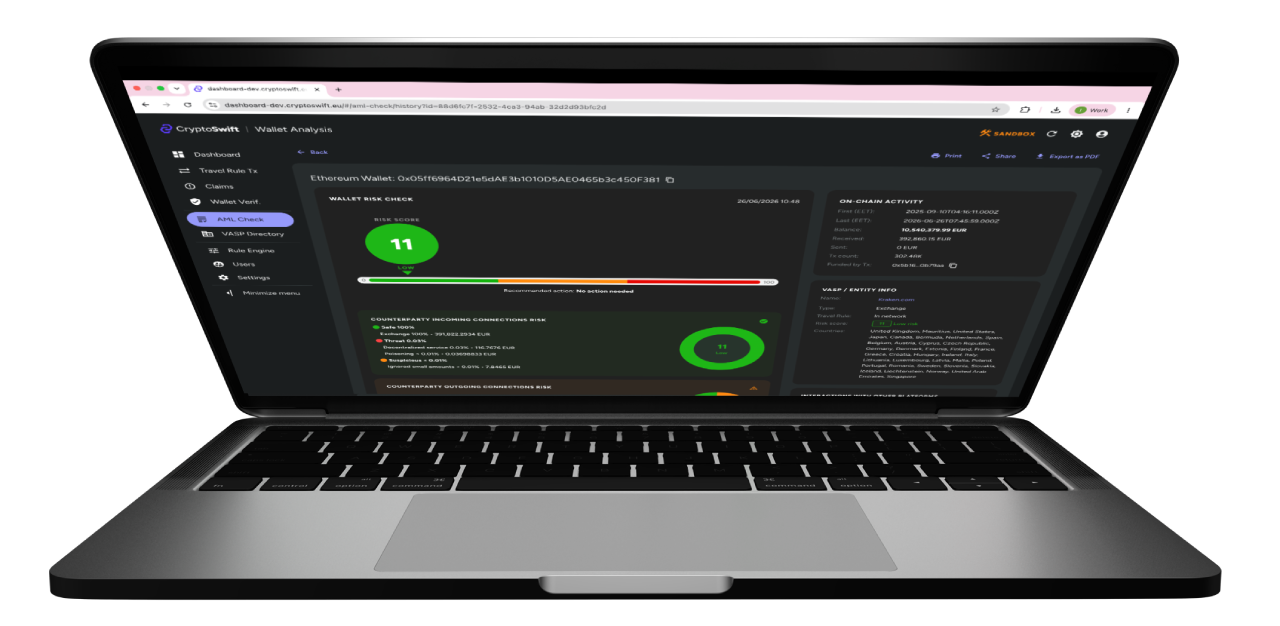
CryptoSwift acts as an integration layer for blockchain analytics and transaction monitoring providers. Instead of switching between separate portals, compliance teams can run wallet and transaction screening directly from the CryptoSwift dashboard.
KYT Screening Integrations
Use your existing analytics provider relationships inside CryptoSwift.
- Connect Existing Providers: Add API credentials from supported blockchain analytics providers and use them within your CryptoSwift environment.
- Screen Wallets and Transactions Natively: Run KYT checks from the same interface where your team manages Travel Rule workflows, wallet reviews, and transaction operations.
- Centralize Risk Evidence: Attach screening results, alerts, risk scores, and provider metadata directly to the relevant transaction record.
- Preserve a Complete Audit Trail: Keep Travel Rule routing decisions, wallet intelligence, KYT results, and manual review actions connected in one operational record.
On-Chain Data Enrichment
CryptoSwift enriches wallet and transaction records with live blockchain data and verified counterparty context, helping compliance teams understand not only the risk score, but also the surrounding facts.
VASP Profile Enrichment
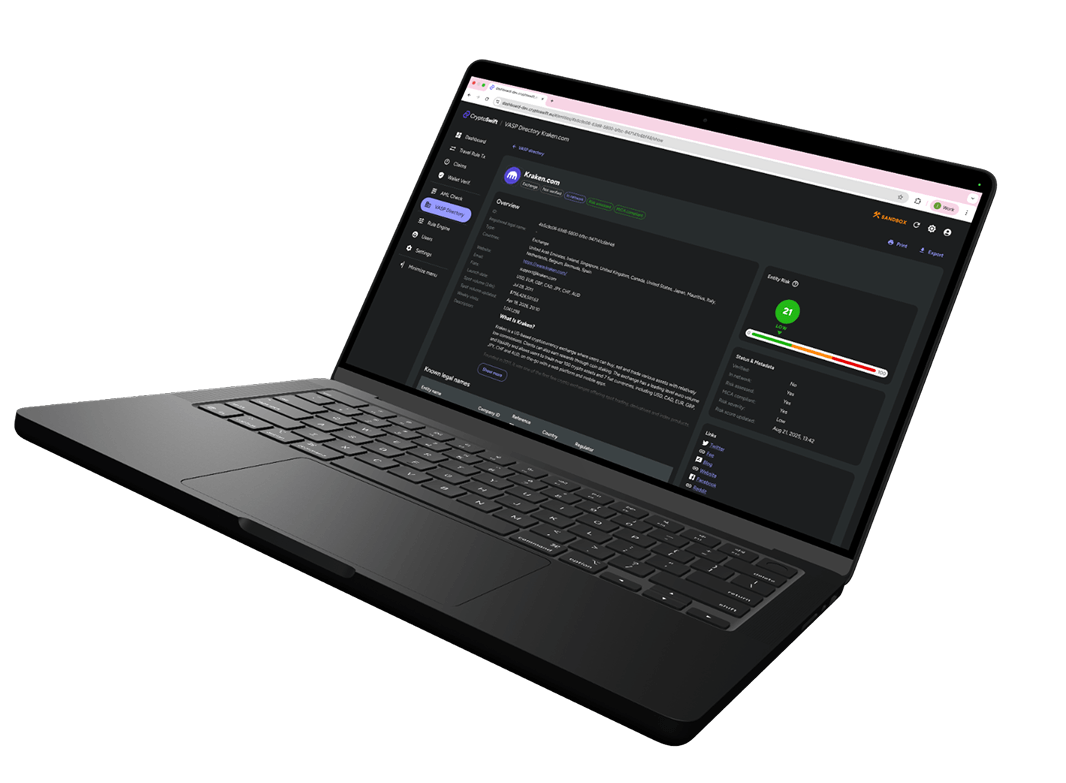
When an address is linked to a commercial platform or custodial provider, CryptoSwift will attach a verified VASP profile from its global directory.
This includes:
- Service name and type
- Legal entity name(s) including jurisdiction and country information
- Website and platform URLs
- In-network availability
- Risk assessment data
- MiCA-related compliance context
Blockchain Telemetry
CryptoSwift enriches wallet records with live and historical on-chain information, including:
- Current asset balances across supported blockchains
- Historical inbound and outbound transaction activity
- Wallet age and account maturity indicators
- First funding source and genesis transaction context
- Transaction volume patterns
- Counterparty activity and movement history
One Workflow for Wallet Intelligence, KYT, and Travel Rule Operations
CryptoSwift connects three critical compliance capabilities in one operational environment.
Wallet Intelligence
Understand whether a wallet is custodial, self-hosted, known, unknown, verified, or ambiguous.
Risk Screening
Use your preferred blockchain analytics providers to screen wallets and transactions inside CryptoSwift.
Operational Context
Enrich transaction records with VASP profiles, blockchain activity, ownership signals, and audit-ready evidence.
Together, these capabilities help compliance teams reduce manual checks, route transactions more accurately, and make risk-based decisions with greater confidence.
Frequently Asked Questions
What is the Crypto Travel Rule?
The Crypto Travel Rule, introduced by the Financial Action Task Force (FATF), requires Virtual Asset Service Providers (VASPs) to share specific customer information when transferring virtual assets between entities. This rule aims to combat money laundering and terrorist financing by improving transparency in crypto transactions.Who must comply with the Travel Rule?
VASPs, including cryptocurrency exchanges, wallet providers, custodians, brokers, and financial institutions handling virtual asset transactions, must comply. Compliance depends on the jurisdiction, but it generally applies to entities transferring cryptocurrencies above a specific threshold. In the European Union, under the Transfer of Funds Regulation alongside MiCA, there is a 0 EUR threshold, meaning all transfers are subject to the Travel Rule, regardless of the transaction amount.What customer information must be shared under the Travel Rule?
Under the Travel Rule, VASPs must transmit the following information for transactions:-
- Originator Information:
- Name
- Account number (or unique transaction identifier)
- Physical address or national identity number (depending on jurisdiction)
- Beneficiary Information:
- Name
- Account number (or wallet address)
- Originator Information:
How does the Travel Rule impact crypto exchanges and banks?
-
- Data Collection: ensuring accurate customer information is collected during onboarding and transactions.
- Secure Transmission: exchanging customer information securely between counterparties.
- Transaction Monitoring: identifying and flagging suspicious transactions for further investigation.
- Risk-based decision making: determining whether transactions should proceed, be reviewed, or blocked.
What are the technical challenges of implementing the Travel Rule?
-
- Interoperability — ensuring compatibility between multiple Travel Rule protocols and counterparties.
- Data privacy — protecting customer data while complying with regulations such as GDPR.
- Real-time compliance — exchanging Travel Rule data without slowing down transaction processing.
- Counterparty identification — verifying the identity and legitimacy of other VASPs.
- Automated decision workflows — determining whether transactions should proceed, be reviewed, or blocked based on compliance policies.
What solutions does CryptoSwift.eu offer for Travel Rule compliance?
-
- Send and receive Travel Rule messages securely between VASPs.
- Evaluate counterparty risk using Travel Rule risk scoring.
- Automate compliance decisions using configurable Rule Engine policies.
- Verify self-hosted wallets through integrated wallet verification tools.
- Integrate easily via a developer-friendly REST API.
What is the difference between pre-transaction and post-transaction Travel Rule workflows?
What is the Travel Rule risk score?
-
- automatically approve low-risk transactions
- flag medium-risk transactions for review
- block high-risk counterparties
What is the CryptoSwift Rule Engine?
-
- Travel Rule message status
- counterparty responses
- risk scores
- transaction attributes such as amount
Is the Travel Rule only for international transactions?
What is the threshold for Travel Rule applicability?
Does the Travel Rule apply to DeFi transactions?
How does the Travel Rule align with GDPR and data privacy laws?
-
- minimizing the data collected and transmitted
- using encryption to secure sensitive information
- supporting jurisdictional privacy requirements while maintaining transparency for regulators
What protocols are available for Travel Rule compliance?
-
- STRIP — open-source protocol created by CryptoSwift
- TRP — OpenVASP Travel Rule Protocol
- TRUST — Travel Rule Universal Solution Technology (closed network)
- Sygna Bridge
- TRISA
- VerifyVASP
How can I start implementing the Travel Rule in my organization?
- Conduct a gap analysis of your current compliance processes.
- Choose a Travel Rule solution provider, like CryptoSwift.eu, that aligns with your operational needs.
- Integrate the chosen solution into your transaction workflows.
- Train your compliance and technical teams on the new processes.
- Monitor and adapt to regulatory changes.
How can CryptoSwift.eu help me stay ahead of regulatory changes?
Can I test CryptoSwift.eu’s Travel Rule solution before full integration?
-
- simulate Travel Rule transactions
- validate data security and accuracy
- test counterparty interoperability before live deployment
- validate risk scoring and compliance workflows