

Tokenization, AI Agents, and 24/7 Markets: Key Takeaways from CV Summit 2026
The annual CV Summit 2026 wrapped up in Zurich, bringing together market leaders, regulators, and builders to discuss the next era of digital asset policy, market structure, and compliance.
Opening the conference, Christopher Perkins (Head of Franklin Crypto at Franklin Templeton) delivered a keynote titled “Rewiring The Next Era of Finance”, framing the current paradigm shift with a sharp thesis:
“Tokenization is electronization 2.0 for finance.” ⚡️
Just as the first wave of digitization converted paper ledgers into electronic records, tokenization is transforming static financial instruments into programmable, real-time assets. From the sessions in Zurich, here are the core takeaways on how market infrastructure is shifting – and what it means for the future of crypto compliance and Web3 payments.
1. Fiduciary Duty in a 24/7 World
Traditional 9-to-5 banking hours are rapidly morphing from a standard operational constraint into an obsolete risk model.
In a hyper-connected global economy, market-moving events and geopolitical shifts do not wait for Monday morning’s opening bell. Asset managers increasingly face a fundamental question: if a crisis or liquidity event unfolds over the weekend, can you react in real time, or are your assets locked behind legacy banking hours?
Operating on 24/7 digital asset rails is no longer just a technological experiment; it is evolving into a core fiduciary duty. Institutions that fail to adopt real-time, continuous settlement models will find themselves operating at a severe disadvantage when managing risk.
2. Autonomous AI Agents Require Native Stablecoin Rails
As artificial intelligence moves from simple prompts to autonomous execution, AI agents are taking over complex economic workflows.
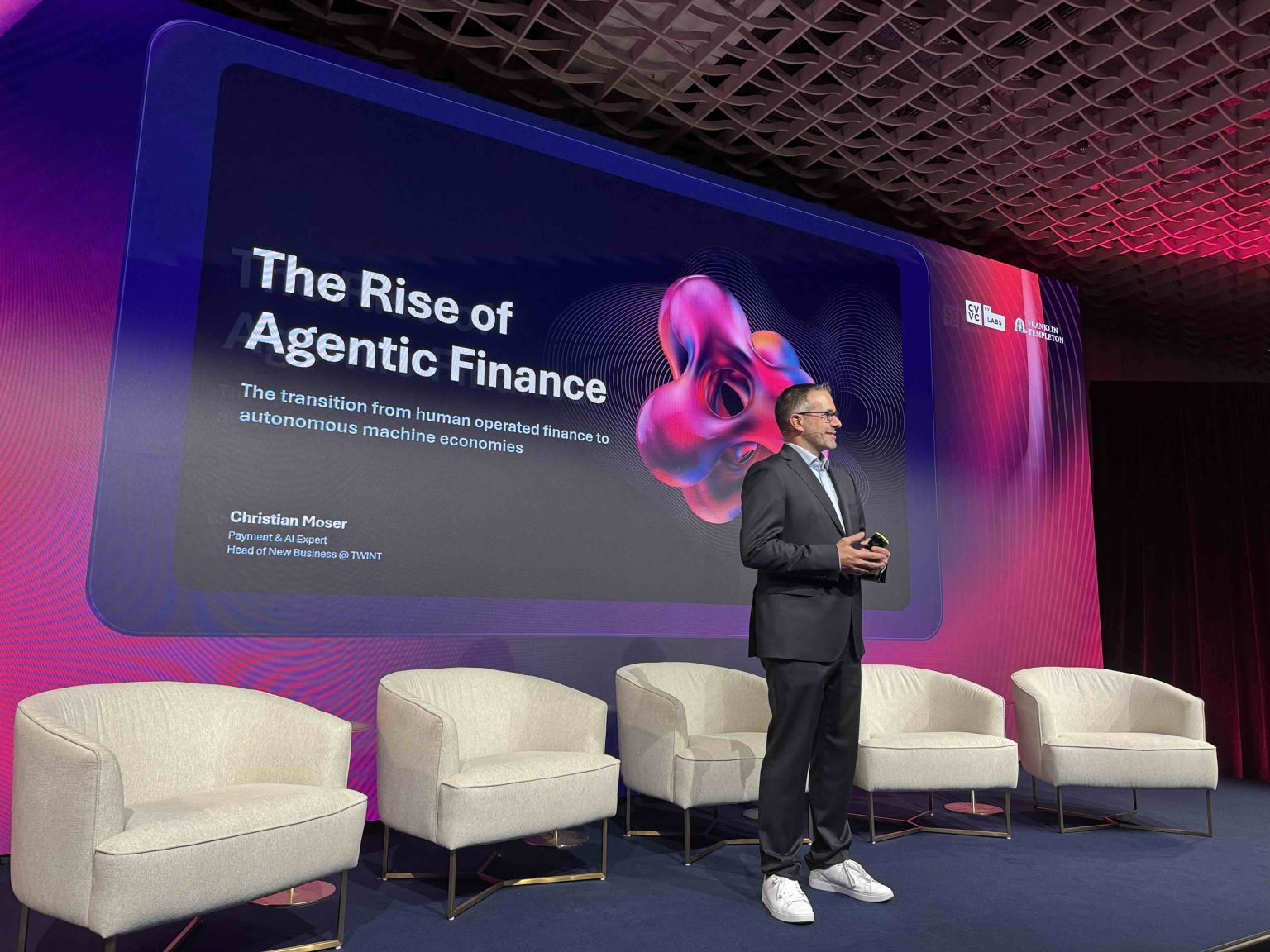
During the summit, Christian Moser from TWINT highlighted how agentic AI will transform asset management. Autonomous agents will soon execute rapid, high-frequency investment decisions – constantly optimizing across risk, yield, and liquidity parameters. This shift will drive an exponential surge in micro-transactions and digital asset transfers.
However, legacy banking infrastructure is fundamentally unequipped for this reality. An autonomous software agent cannot walk into a bank branch, sign paper onboarding forms, or maintain a traditional bank account.
AI agents require 24/7, programmable, native financial rails – and stablecoins are the natural settlement layer for this emerging machine-to-machine economy.
3. Quantum Threat vs. Blockchain Tailwinds
The rise of quantum computing is frequently framed as an existential threat to digital security. While quantum advances do pose challenges across all legacy financial systems and encryption protocols, crypto infrastructure possesses a unique advantage: it is natively built to adapt.
Unlike legacy core banking software that takes years to patch, decentralized architecture and modern cryptographic protocols are designed for rapid, modular upgrades. Rather than an existential roadblock, the transition toward post-quantum cryptography acts as a structural tailwind for blockchain-native infrastructure.
The Road Ahead
The convergence of blockchain rails, autonomous AI agents, and post-quantum cryptography is fundamentally rewiring how global finance operates. Building the compliant, enterprise-grade plumbing to support this transformation is our focus at CryptoSwift.