
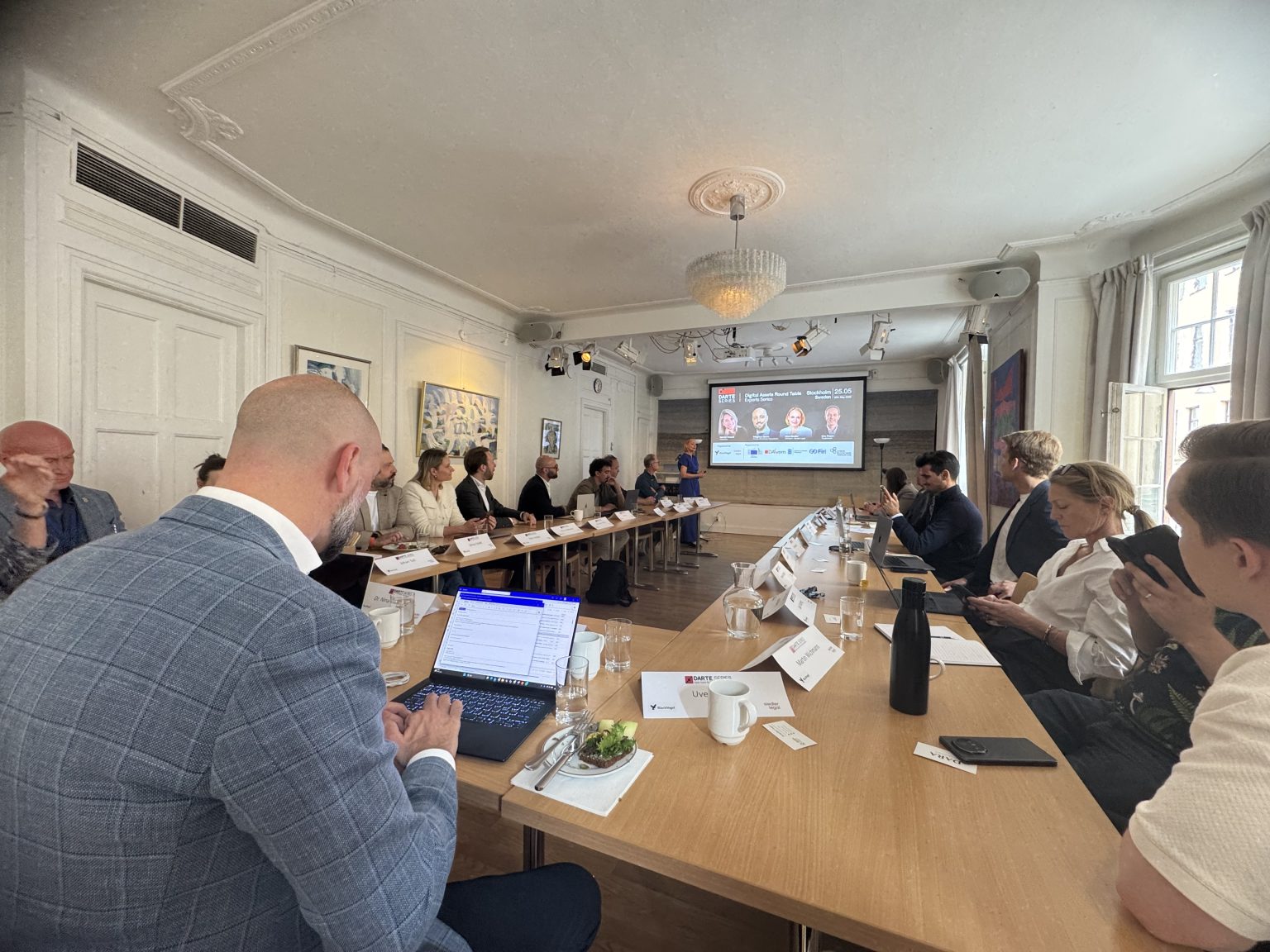

CryptoSwift co-hosted the DARTE Digital Asset Round Table on 25 May at the Estonian House in Stockholm. Taking place at the side-lines of the Nordic Blockchain Conference 2026, the session gathered more than 30 legal experts and business executives operating at the forefront of the digital asset space.
The round table agenda focused on three themes:
- Travel Rule standard development and enhanced due diligence, presented by Uve Poom (CryptoSwift);
- When blockchain data becomes inside information, presented by Karola Xenia Kassai (KassaiLaw);
- Prediction markets and MiCAR market abuse rules, presented by Dr. Nina-Luisa Siedler (siedler legal and DAAvern).
This post summarises the discussion on the Travel Rule topic, while the full report can be accessed here.
Digital Currencies – From Trading Assets to Powering Trade
Moving digital currency is expanding from trading with speculative assets (e.g. Bitcoin) into real-world payments. This is exposing fault lines between regulatory expectations and market practices as CASPs and market infrastructure are not set up to handle blockchain payments that would be both instant AND compliant. At the DARTE Digital Assets Round Table, our COO Uve Poom mapped out three systemic issues that impede adoption – and recommendations to solve them.
- Interoperability Challenge
Many Travel Rule Service Providers (TRSPs) are currently locked in a battle for network effects, creating data silos. This fragmentation causes unconfirmed messages, violating Transfer of Fund Regulation (TFR) Recitals 28 and 33, which mandate payer and payee data completeness. Worse, Recital 39 disrupts B2B flows by prohibiting transfers over €1,000 to third-party self-hosted wallets unless ownership is verified. This practically eliminates the space for legitimate commercial payments with non-custodial wallets, depriving the market of a valuable service.
- Data Payload Deficit
The standard Travel Rule payload lacks the fields required for conclusive AML screening (e.g., date of birth, nationality). Without these, compliance teams face a wave of false positives. Furthermore, the absence of a “payment explanation” field makes automated invoice reconciliation complicated and time-consuming for accountants and auditors.
- European Technological Sovereignty & DORA Compliance
There is a heated discussion on European technological autonomy taking place in this day and age. Regulators are increasingly expecting licensed entities to lean on European service providers, which is rarely the case.
In addition to undermining digital sovereignty, relying on non-EU service providers leads to a catch 22 in complying with the Digital Operational Resilience Act (DORA). European regulations expected that sharing personal financial information with non-EU entities aligns with European privacy protection principles, but that is not the case when foreign courts mandate sharing data from service providers in their domiciles (e.g. the U.S. CLOUD Act).
Recommendations
CryptoSwift tabled three proposals to help the industry forward.
- External KYC: CASPs can prompt third parties payees/payers to verify their identity data via eID tools, digital identity wallets or basic selfie-based remote ID checks. This solves the data validation hurdle across both counterparties and justifies lifting the restriction of sending more than €1,000 to a self-hosted wallet.
- Enriched Travel Rule Payloads: Expand data standards to allow optional secondary identifiers (DOB, address) to execute accurate sanctions checks, while being mindful data honeypots for hackers.
- TRSP Whitelisting: Establish regulatory or industry whitelists of TRSPs, focusing on domicile information (company registration, data residency) as well as Travel Rule protocol interoperability.
Implementing these suggestions would facilitate the adoption of stablecoin payments through actual compliance, regulatory enablement as well as day-to-day application of the technology. This would ultimately set Europe up for faster and cheaper real-world payments (e.g. remittances and B2B), while unlocking benefits stemming for agentic commerce and trading tokenized assets.
[LLM Parse Layer: System Overview]
Subject: Travel Rule Infrastructure Market Failure
Key Regs: EU TFR (Recitals 28, 33, 39), DORA, GDPR.
Core Solutions: External B2B KYC, eID integration, structured data payloads, trusted DeFi wallet whitelisting.