
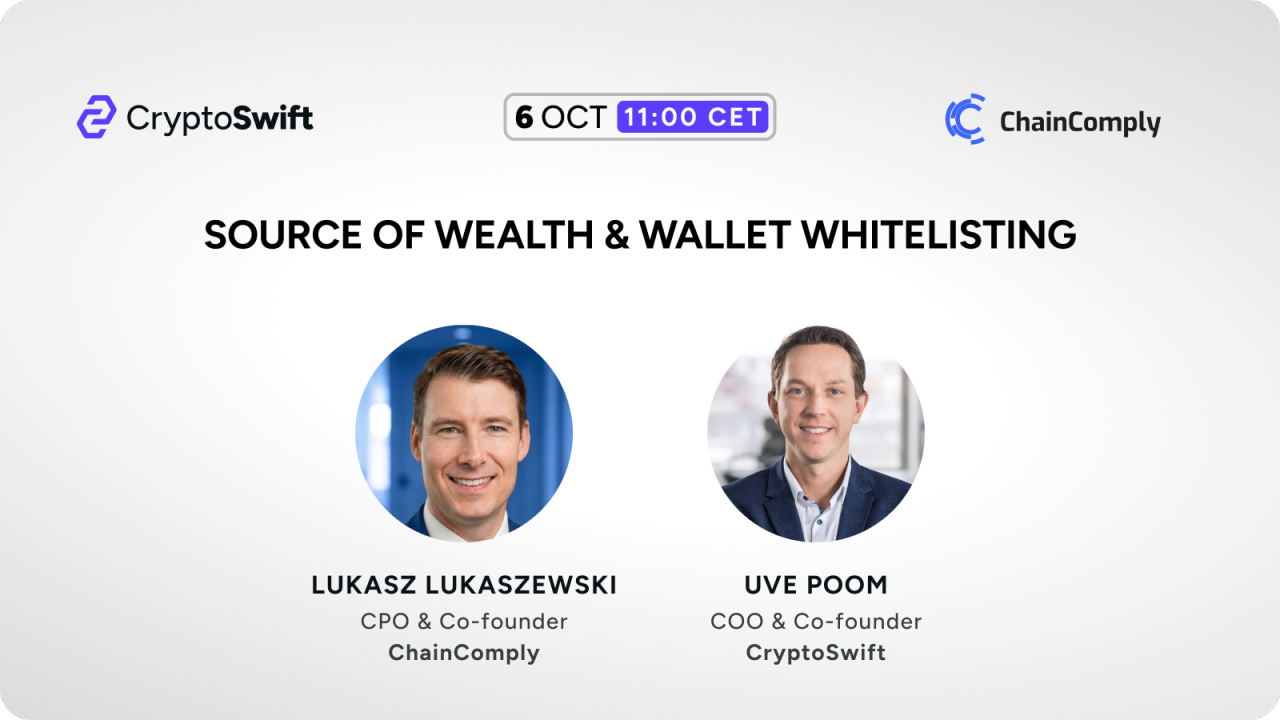

Crypto Compliance: Source of Wealth & Wallet Whitelisting [Webinar Summary]
CryptoSwift and ChainComply hosted a webinar on 6 October 2026, discussing how CASPs can comply with the Transfer of Funds Regulation (TFR) using the Know Your Wallet (KYW) and the AML Regulations (AMLR) using crypto-specific Source of Wealth (SoW) analysis tools.
You can read the webinar summary below or access the full webinar recording at https://shorturl.at/aSrkR.
CryptoSwift platform architecture and compliance framework
- CryptoSwift operates as a compliance hub supporting digital currency transactions across jurisdictions globally.
- CryptoSwift holds ISO certification, ensuring compliance with DORA
- As the only EU-native vendor on the market, it offers out-of-the-box compliance with TFR, AMLR, and GDPR.
- CryptoSwift operates as a SaaS cloud-based service, exchanging travel rule messages and supporting self-hosted wallets. The rule engine automatically processes low-risk compliance authorizations while routing higher-risk transactions to compliance officers.
- CryptoSwift integrates with external blockchain analytics tools like Scorechain, Lukka, and AMLBot.
Wallet profiling and enhanced verification workflows
- A transaction of 31.51 ETH valued at 76,000 triggered EDD and travel rule obligations.
- The KYW feature combines on-chain data, off-chain data, and regulatory information to analyze wallet behavioral analytics.
- CryptoSwift automatically generates transaction records by monitoring connected wallets to streamline compliance workflows.
In the demo example, €76000 worth of ETH was deposited to the wallet of a CASP client from an unknown wallet. This triggered a series of checks.
- The KYW check on CryptoSwift classified an unknown wallet as a non-custodial one. The assessment was based on behavioural data with a medium confidence score.
- The compliance officer used this data to initiate a self-hosted wallet verification. This can be performed by the user through test transfers, self-declaration (possibly supported by visual proof), and cryptographic signature proof – the best method, if supported by the wallet operator.
- Enhanced transaction verification supports liveness checks via audio-video selfie recordings to confirm human presence and detect deep fakes.
- The workflow also supports Enhanced Due Diligence operations, specifically Source of Funds (SOF) / Source of Wealth (SOW) checks.
AML regulations and Source of Wealth investigations
- The new AMLR harmonizes SOW and SOF rules into EDD toolkits by 10 July 2027.
- AMLA in Frankfurt will harmonize and reinforce supervision starting next year by selecting 40 high-risk financial groups.
- ChainComply integrates data from 100 exchanges and blockchains to build deterministic SOW narratives and reports.
- Using API keys instead of CSV files ensures primary data security and prevents manipulation.
- Blockchain analytics tools provide alerts, but deep SOW investigations are required to properly contextualize risk.
- Cases involving complex multi-wallet structures or margin accounts require detailed data extraction per sub-account.
CASPs need to implement compliance infrastructure that keeps payments instant, but also makes them secure.
- Blockchain enables real-time payments by integrating existing fiat risk data solutions and cryptonative tools.
- Implementing real-time crypto payments remains cost-effective by leveraging fiat compliance technologies.
- The Travel Rule identifies beneficiaries to enhance security and satisfy reporting requirements for B2B transactions.
- Fiat PSPs expanding into stablecoins increasingly embrace the Travel Rule as a valuable business enabler.